Content Marketing Strategy for Australian Businesses: A Practical Guide to Driving Leads in 2026
Australian businesses are producing more content than ever before. Blog posts, LinkedIn updates, email newsletters, Instagram reels, podcasts — the volume of content being created across the country has never been higher. And yet, when I talk to business owners and marketing managers every single week, the same frustration comes up: "We're publishing consistently but we're not seeing any leads from it."
The problem is not a lack of content. The problem is a lack of strategic intent. Most businesses treat content marketing like a publishing exercise rather than a lead generation engine. They write blog posts because someone told them blogging was good for SEO. They post on LinkedIn because their competitors are doing it. They send email newsletters with no clear objective beyond "staying top of mind." Without a coherent strategy connecting your content to a specific audience, a specific problem, and a specific conversion pathway, you are essentially producing noise.
This guide is designed to cut through that noise. Whether you are a mortgage broker trying to attract more refinance enquiries, a recruitment firm building authority in your vertical, or a B2B professional services business trying to shorten your sales cycle, the principles here apply directly to your situation. I will walk you through why most Australian content marketing fails, how we build strategies at 3P Digital that actually drive pipeline, which formats and channels perform best in the Australian market, and how to measure your return with clarity. Let us get into it.
Key Takeaways
Content marketing only generates leads when it is built around a clearly defined Ideal Customer Profile (ICP) and mapped to buyer intent stages.
Most Australian businesses fail at content because they have no distribution plan — publishing is only half the work.
The highest-performing content formats for Australian SMEs are long-form SEO content, comparison guides, case studies, and gated lead magnets.
LinkedIn is the single most effective distribution channel for B2B content marketing in Australia in 2026, but it requires a different content strategy than organic search.
Measuring content ROI requires looking beyond traffic and page views — assisted conversions, content-attributed pipeline, and engagement-to-enquiry ratios are the metrics that matter.
A consistent publishing cadence of two to four pieces of quality content per month outperforms high-volume, low-quality content strategies every time.
Summary Table
Content Type | Best For | Buyer Stage | Lead Gen Potential | Typical Time to ROI |
Long-form SEO blog posts | Organic search, SME and B2B | Awareness to Consideration | High (3-6 months) | 3-9 months |
Comparison guides | High-intent search traffic | Consideration to Decision | Very High | 2-6 months |
Case studies | Trust building, sales enablement | Decision | Very High | Immediate (sales cycle) |
Gated assets (eBooks, templates) | Lead capture, email list growth | Awareness to Consideration | High | 1-3 months |
Industry calculators | High intent, shareable | Consideration to Decision | Very High | 2-4 months |
LinkedIn thought leadership | B2B audience, warm pipeline | Awareness to Consideration | Medium-High | 1-3 months |
Email nurture sequences | Existing leads, warm prospects | Consideration to Decision | Very High | Immediate |
Video content | Brand awareness, social reach | Awareness | Low-Medium | 6-12 months |
Why Most Content Marketing Fails in Australia
Before we talk about what works, we need to be honest about what does not. In my experience working with Australian SMEs across mortgage broking, recruitment, professional services, and fitness, there are four consistent failure modes that explain why most content programs produce almost zero commercial outcomes.
No ICP Alignment
The most common mistake is creating content for "everyone." A mortgage broker writes a post titled "How to Get a Home Loan" and wonders why it does not convert. The problem is that the content is not written for a specific person with a specific problem at a specific life stage. Compare that to "Home Loan Options for Self-Employed Business Owners in 2026" — that piece speaks directly to a defined ICP, addresses a genuine pain point, and signals relevance immediately.
ICP alignment is not just about picking a niche. It is about understanding the language your ideal customer uses, the questions they type into Google, the objections they carry into a sales conversation, and the outcomes they are actually trying to achieve. At 3P Digital, every content engagement starts with ICP development before a single word is written. If you skip this step, every piece of content you produce is a guess.
No Distribution Plan
Publishing a blog post and sharing it once on Facebook is not a distribution strategy. In a competitive market like Australia, where you are often competing against large publishers, national brands, and globally funded content operations, the assumption that good content will find its own audience is dangerously naive.
Content distribution needs to be planned before the content is created, not after. For every piece of content we produce, we ask: where will this live, who will see it, how will we drive traffic to it in the first 72 hours, and how will we give it a long tail through search? If you cannot answer those questions before you hit publish, you are wasting your budget.
Vanity Metrics
Australian marketing teams are often measured on page views, social impressions, and follower counts. These metrics feel good and they are easy to report upward. They are also almost entirely disconnected from commercial outcomes.
I have seen companies celebrate 50,000 monthly blog visitors while generating zero qualified leads. I have seen LinkedIn posts with 10,000 impressions produce no pipeline. Vanity metrics are not useless — they tell you something about reach and resonance — but they should never be the primary KPI for a content program that is supposed to generate business.
No Conversion Pathways
Content that informs but does not convert is a publishing operation, not a marketing operation. Every piece of content you create should have a clear next step for the reader. That next step should be calibrated to the buyer stage the content targets.
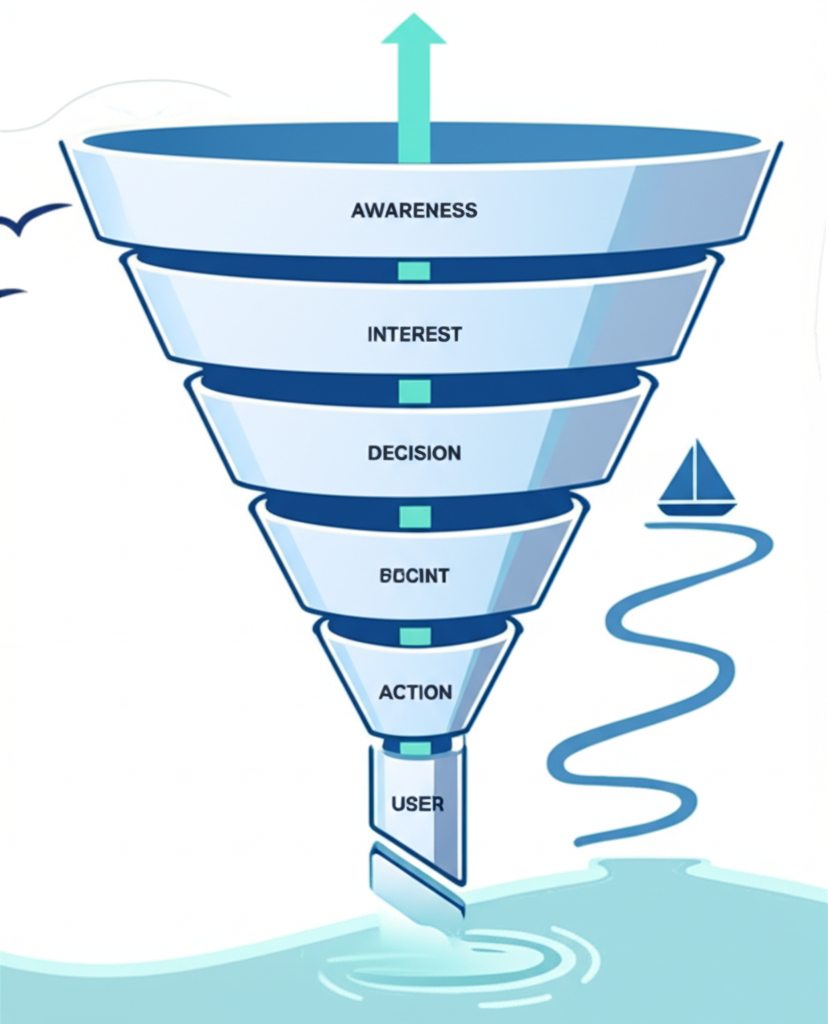
Awareness-stage content should move readers toward an email list, a gated asset, or further exploration of your site. Consideration-stage content should move readers toward a case study, a comparison guide, or a consultation booking. Decision-stage content should have a direct call to action to get in touch or start a trial. Without these pathways, you are generating traffic with nowhere to go.
Building a Content Strategy Using the 3P Framework
At 3P Digital, every engagement — whether it is SEO, paid media, or content marketing — runs through our proprietary 3P Framework: Profile, Plan, Perform. It is not a gimmick. It is a structured way to ensure that strategy always precedes execution and that measurement is built in from the start.
Profile: Audience Research and Intent Mapping
The Profile phase is where most agencies skip ahead and most in-house teams cut corners. Before any content is planned or produced, we need to understand three things with precision:
Who are we talking to? This means developing a detailed ICP that goes beyond demographics. What industry are they in? What size is their business? What role do they play in the buying decision? What are their primary business pressures in 2026? For example, a recruitment firm's ICP might be an HR Manager at a 50-200 person Australian business who is struggling with time-to-hire and candidate quality, not headcount budget.
What are they searching for? Intent mapping is the process of identifying the specific questions your ICP types into Google at each stage of their buying journey. We use a combination of keyword research tools, Google Search Console data, competitor gap analysis, and actual sales call recordings to build this map. The output is a prioritised list of topics tied to search volume, intent classification (informational, commercial, transactional), and competitive difficulty.
Where do they spend their time online? Not every audience is active on LinkedIn. Not every audience reads long-form blog content. Understanding where your ICP discovers, evaluates, and decides is essential to building a distribution strategy that reaches them. For B2B audiences in Australia, LinkedIn and Google search remain the dominant channels. For consumer-facing businesses, email and organic search are typically where the highest-intent traffic lives.
Plan: Content Calendar Tied to Buyer Journey Stages
Once the Profile phase is complete, we build a content plan that is explicitly mapped to buyer journey stages. This is not a generic editorial calendar. Every piece of planned content has a defined purpose, a target audience segment, a target keyword or distribution channel, a content format, and a conversion goal.
A practical content plan for an Australian B2B business in 2026 might look like this across a quarter:
Awareness (top of funnel): Two long-form SEO blog posts targeting high-volume, informational keywords in the target industry. Goal: organic traffic and email list growth.
Consideration (middle of funnel): One detailed comparison guide and one case study. Goal: move warm traffic toward a consultation or demo booking.
Decision (bottom of funnel): One email nurture sequence of four to six emails targeting leads who have engaged with top-of-funnel content. Goal: convert warm leads into enquiries.
Distribution: LinkedIn content repurposed from the blog posts published three times per week. Goal: reach ICP directly in their feed.
The key principle here is constraint. It is better to do four things well than twelve things poorly. Under-resourced marketing teams consistently over-commit on content volume and under-deliver on content quality and distribution. We recommend starting with a cadence you can sustain with excellence before scaling.
Perform: Publish, Distribute, Measure, Iterate
The Perform phase is where strategy becomes execution. Publishing is only the beginning. A structured perform phase includes:
Distribution within 72 hours of publishing. Every piece of content gets an immediate distribution push. This includes email to the existing list (if relevant), LinkedIn posts from both the company page and the founder's personal profile, internal linking updates on the site, and outreach to any sources or partners mentioned in the piece.
On-page conversion optimisation. High-traffic content pages should be regularly reviewed for conversion rate. Are the CTAs visible? Is the offer relevant to the content? Is the page loading fast on mobile? In Australia, where mobile traffic now accounts for over 60% of organic search sessions, mobile experience is non-negotiable.
Monthly performance review. We review content performance monthly across four metrics: organic sessions, engagement rate, assisted conversions, and scroll depth. Content that is ranking but not converting gets a CRO pass. Content that is not ranking gets a keyword and structural review. Content that is performing gets amplified through paid distribution.
Quarterly content audit and iteration. Every quarter, underperforming content is either updated, consolidated, or retired. Thin content that was published before the strategy was in place is a particular problem for businesses that have been blogging without strategy. A content audit often reveals that 20% of your content is generating 80% of your organic value — and the rest is either neutral or actively diluting your domain authority.
Content Formats That Drive Leads for Australian SMEs
Comparison Guides
Comparison content is among the highest-converting content formats available to Australian SMEs in 2026. Buyers who are comparing options are, by definition, in the consideration to decision stage of their journey. Capturing them with content that helps them make an informed choice — while naturally positioning your product or service favourably — is one of the most direct paths from content to conversion.
A mortgage broker, for example, might produce a guide titled "Fixed vs Variable Rate Home Loans in 2026: Which Is Right for You?" This piece targets a high-intent keyword, serves a reader who is actively evaluating their options, and provides a natural CTA for a personalised consultation. A recruitment firm might produce "Contingency vs Retained Recruitment: What Australian Businesses Need to Know" — same principle.
The best comparison guides are genuinely useful and balanced. Readers can smell a sales pitch disguised as a comparison guide immediately. Provide real pros and cons, acknowledge where your solution is not the best fit, and earn the trust that converts to enquiries.
Case Studies
Case studies are the most underutilised content asset in Australian SME marketing. Most businesses have done impressive work for impressive clients and never document it in a way that is commercially useful. A well-structured case study does three things: it demonstrates capability, it provides social proof, and it allows prospective buyers to see themselves in the client's situation.
Our most effective case studies for clients follow this structure: the client's situation before engaging us, the specific problem they were trying to solve, the strategy and tactics we deployed, the measurable outcomes, and a direct quote from the client. Short, specific, and results-focused. You can see examples of this approach in our case studies.
For SEO value, case studies should be structured around long-tail keywords that prospective clients might search — for example, "content marketing results for mortgage broker Australia" or "lead generation for recruitment agency." This is a tactic very few Australian businesses are executing well, which means there is genuine competitive opportunity here.
Industry Calculators and Interactive Tools
Calculators are exceptional lead generation assets because they provide immediate, personalised value in exchange for engagement or contact details. A mortgage broker might offer a "Borrowing Capacity Calculator" or a "Refinance Savings Estimator." A recruitment firm might offer a "Cost of a Bad Hire Calculator." A fitness business might offer a "Calorie Deficit and Weight Loss Timeline Calculator."
The lead generation mechanic can be structured in two ways: require an email address to see the results (higher friction, higher lead quality), or provide results freely and use the tool as a traffic and trust builder with soft CTAs. Both approaches work depending on your funnel economics. In our experience, calculators with results shown freely but with an email capture for a detailed report strike the best balance between conversion volume and lead quality.
Long-Form SEO Content
Long-form content targeting informational keywords remains one of the highest-ROI content investments for Australian SMEs. The reason is simple: Google continues to reward comprehensive, authoritative content that thoroughly addresses search intent. A 2,500-word guide that genuinely answers a question in depth will, in most Australian markets, outrank a 600-word post that skims the surface.
The key to making long-form content work is selecting the right keyword targets. We use a combination of search volume, keyword difficulty, and commercial intent to prioritise topics. A keyword with 500 monthly searches in Australia but very high commercial intent (meaning the person searching is likely a buyer) is almost always more valuable than a keyword with 5,000 monthly searches but purely informational intent.
Our SEO services and content marketing are deliberately integrated for this reason. Content that does not rank generates no compounding value. Content that ranks but does not convert generates traffic with no ROI. The intersection of strong SEO and strategic content is where the real lead generation happens.
Gated Assets
Gated assets — eBooks, templates, checklists, frameworks, whitepapers — are the foundation of email list growth for B2B businesses. The principle is simple: provide something genuinely valuable in exchange for an email address, then nurture that lead through a sequence that builds trust and drives conversion.
The most common mistake Australian businesses make with gated assets is producing content that is too generic. "The Ultimate Guide to Digital Marketing" will not convert because it is not specific enough to your ICP's problem. "The Mortgage Broker's Checklist for Converting Refinance Leads in 2026" will convert because it is hyper-specific, immediately relevant, and positions you as an expert in that exact problem.
Distribution Channels That Actually Work
Organic Search
Organic search remains the highest-ROI content distribution channel for most Australian businesses over a 12-month horizon. Content that ranks on page one of Google generates compounding traffic with no ongoing cost per click. The challenge is that it takes time — typically three to nine months for a well-optimised piece to reach its ranking potential — and it requires an integrated approach to both content quality and technical SEO.
For Australian businesses, the competitive landscape in organic search varies significantly by industry. In mortgage broking and financial services, the competition from major banks and aggregators is intense, which means content strategy needs to focus on long-tail and niche keywords where smaller operators can genuinely compete. In recruitment, professional services, and fitness, the opportunity for well-structured original content to rank is considerably stronger.
LinkedIn for B2B
LinkedIn is the dominant social platform for B2B content marketing in Australia in 2026. With over 6 million Australian users and high engagement rates among business decision-makers, it offers direct access to the exact audience that most B2B businesses are trying to reach.
The most effective LinkedIn content strategy for Australian B2B businesses is built around personal profiles rather than company pages. Founders, directors, and senior practitioners who share genuine insight, client outcomes, and industry perspective consistently outperform company page posts in reach and engagement. This is not a knock against company pages — they serve an important credibility and social proof function — but personal profile content is where organic reach lives on LinkedIn.
The content format that performs best on LinkedIn for Australian B2B audiences is the short-form text post with a narrative hook. Posts that start with a contrarian statement, a client story, or a specific result consistently generate more engagement than generic advice posts. Repurposing your long-form blog content into a series of LinkedIn posts is one of the most efficient content strategies available — one blog post can generate four to six LinkedIn posts with minimal additional effort.
Email Nurture
Email remains the highest-converting marketing channel for businesses with an existing lead database. A well-structured nurture sequence can take a cold or lukewarm lead and move them through the consideration stage without any manual sales effort.
For Australian SMEs, the most effective email content sits in the 200 to 400 word range, has a single clear CTA, and provides genuine value rather than a thinly veiled sales pitch. Personalisation beyond the first name — referencing the industry the subscriber is in, the lead magnet they downloaded, or the page they visited — dramatically increases open rates and click-through rates.
Email list health is also a critical factor. Australian businesses should clean their lists quarterly, removing inactive subscribers to maintain deliverability. With Australian Spam Act compliance requirements, list hygiene is also a legal obligation, not just a best practice.
Content Syndication
Content syndication — republishing your content on third-party platforms or in industry publications — is an underutilised distribution channel for Australian businesses. Platforms like LinkedIn Articles, Medium, and industry association publications can dramatically extend the reach of content you have already produced.
The key rule for syndication is canonical tagging and sequencing. Always publish on your own site first, ensure the content has been indexed by Google, and then syndicate with a canonical tag pointing back to your original URL. This ensures that the SEO value accrues to your domain, not the syndication platform.
Measuring Content Marketing ROI
One of the most common questions I get from Australian business owners is: "How do I know if my content marketing is working?" The honest answer is that measuring content ROI requires a more sophisticated approach than most businesses currently use.
Assisted Conversions
Most businesses measure conversions by last-click attribution — meaning they give credit for a conversion to the last channel the lead interacted with before converting. Under last-click attribution, content marketing almost always appears to underperform because most content sits at the top of the funnel. The lead reads your blog post, leaves, comes back through Google three weeks later, and converts. In last-click reporting, the blog post gets zero credit.
Assisted conversion reporting in Google Analytics 4 shows you how many conversions included a specific channel or page as a touchpoint, even if it was not the last interaction. This data almost always shows that content marketing is contributing significantly more to pipeline than last-click attribution suggests.
Content-Attributed Pipeline
For B2B businesses with longer sales cycles, tracking content-attributed pipeline — meaning the value of deals in progress where content played a role in the buyer's journey — is a more commercially meaningful metric than conversion counts. If a prospect read three of your blog posts and downloaded a case study before booking a consultation, that content played a direct role in generating that opportunity.
CRM integration is essential for tracking this properly. Whether you are using HubSpot, Salesforce, or a simpler tool, building the habit of recording how leads first engaged with your content creates a dataset that, over time, will clearly demonstrate the ROI of your content investment.
Engagement-to-Enquiry Metrics
For businesses that do not yet have sophisticated attribution in place, a simpler proxy metric is the engagement-to-enquiry ratio on key content pages. Track scroll depth (are readers consuming the full piece?), time on page, and bounce rate on your highest-value content pages, then compare these engagement signals against the enquiry rate for leads who touched those pages. High engagement with low enquiry rates tells you the content is compelling but the conversion pathway needs work. High enquiry rates from low-traffic pages tells you you have a traffic problem, not a content problem.
Industry-Specific Content Plays
Content strategy is not one-size-fits-all. The tactics that drive leads for a mortgage broker are different from those that work for a recruitment firm. Here is how we approach content for the four industries we work with most frequently. You can explore more at our industries page.
Mortgage Broking
Mortgage brokers operate in one of the most competitive content environments in Australian digital marketing. Major banks, comparison sites like Canstar and Finder, and well-resourced aggregators dominate broad keywords. The opportunity for independent brokers lies in niche content targeting specific borrower situations: self-employed borrowers, property investors with multiple properties, first home buyers in specific states, and refinancers evaluating specific lender deals.
The content formats that consistently generate leads for mortgage brokers are: borrower situation guides ("Home Loan Options for Self-Employed Australians"), lender comparison content, calculators (borrowing capacity, stamp duty, repayment comparison), and client case studies framed around specific borrower challenges. Email nurture sequences triggered by calculator use are particularly effective — a borrower who has just used your borrowing capacity calculator is a very warm lead.
Professional Services
For professional services firms — accountants, lawyers, consultants, financial advisers — content marketing serves a dual purpose: it drives organic enquiries and it functions as sales enablement material for the in-person or video consultation stage.
The most effective content for professional services is authoritative, specific, and problem-focused. A commercial lawyer might produce "What Australian SMEs Need to Know About Director Liability in 2026" — a piece that speaks directly to a concern their ICP has, demonstrates expertise, and creates a natural segue into a conversation about legal protection. An accounting firm might produce a guide on "Structuring Your Business for Tax Efficiency Before the End of Financial Year" — relevant, timely, and directly tied to a commercial decision.
Thought leadership on LinkedIn, supported by long-form content on the firm's website, is the highest-performing channel combination for Australian professional services firms in 2026.
Recruitment
Recruitment firms have a dual audience challenge: they need to attract both clients (businesses with hiring needs) and candidates (job seekers). Most recruitment firm content tries to serve both audiences simultaneously and ends up serving neither well.
The most effective approach is to separate your content strategy into two distinct tracks. Client-facing content should focus on hiring challenges, workforce trends, and the business case for specialist recruitment — for example, "The True Cost of a Bad Hire for Australian SMEs" or "How to Write Job Ads That Attract Quality Candidates in 2026." Candidate-facing content should focus on career development, job search strategy, and industry-specific career advice.
LinkedIn is the dominant distribution channel for both tracks. Recruitment consultants who build personal brands on LinkedIn through regular, value-adding content consistently generate more leads than firms relying solely on job board spend and cold outreach.
Fitness and Wellness
For fitness businesses — gyms, personal trainers, online coaches, and allied health professionals — content marketing works best when it is highly specific to a target client profile and outcome. Generic fitness advice is commoditised. "5 Tips to Lose Weight" will not rank and will not convert. "12-Week Strength Training Program for Women Over 40 in Australia" has a chance.
The content formats that generate the most leads for fitness businesses are transformation case studies (with specific before/after metrics), educational content about specific training methodologies, nutrition guides tied to specific goals, and free trial or introductory offer landing pages supported by organic content traffic. YouTube and Instagram are important distribution channels for fitness content, but these platforms require a different content strategy and production investment than text-based content.
Case Study 1: B2B Professional Services Firm — 340% Increase in Organic Leads
A mid-sized Australian management consulting firm came to 3P Digital with a common problem: they were producing monthly blog content but generating almost no organic leads. Their blog was getting roughly 800 sessions per month, but in 12 months, they could attribute only three enquiries to organic content. Their content was well-written but entirely misaligned with buyer intent — they were publishing thought pieces about industry trends rather than content targeting the specific problems their ICP was actively searching for.
We started with a full content audit and ICP mapping exercise. The firm's ideal client was an operations director or CEO at an Australian manufacturing business with 50 to 250 employees, dealing with process inefficiency, rapid growth management, or post-merger integration challenges. None of their existing content addressed these specific problems.
Over six months, we produced 18 pieces of strategically targeted content: six long-form SEO guides targeting high-intent keywords, four detailed case studies structured around client problem and outcome, three comparison guides, and five LinkedIn thought leadership pieces published from the managing director's personal profile. We also built a gated "Operational Efficiency Assessment Template" that captured email addresses for a nurture sequence.
The results at the nine-month mark: organic sessions grew from 800 to 4,200 per month. Content-attributed enquiries went from three per quarter to fourteen per quarter — a 367% increase. The email list grew from 180 to 1,100 subscribers. Three of the new clients, worth a combined $420,000 in fees, cited the firm's content as a significant factor in their decision to reach out. Find out more about how we approach content strategy here.
Case Study 2: Mortgage Broker — From Zero to 40+ Monthly Organic Enquiries
A boutique mortgage brokerage in Brisbane approached us after spending heavily on Google Ads with declining returns. Their cost per lead from paid search had climbed to $185, and their conversion rate from lead to settled loan was 22% — meaning each new client was costing over $840 in acquisition costs before broker time. They wanted to build an organic content engine that would reduce this dependence on paid search.
We identified four niche borrower segments where the broker had genuine expertise and where organic search competition was manageable: self-employed borrowers, property investors with complex portfolios, SMSF property lending, and first home buyers in Southeast Queensland. We built a content plan targeting these segments specifically.
Over nine months, we published 24 pieces of long-form content, built a borrowing capacity calculator (which now generates 600+ monthly sessions), and created a six-email nurture sequence for calculator users. The broker's personal LinkedIn profile, which had been dormant, was activated with a weekly content schedule.
At the twelve-month mark: organic sessions grew from 1,100 to 7,800 per month. The calculator alone generates 35 to 45 email enquiries per month. Google Ads spend was reduced by 60% while total monthly enquiry volume increased by 85%. The broker now generates more than 40 qualified organic enquiries per month at an effective cost per lead under $30. You can explore more client outcomes in our case studies section.
What Our Clients Say
"We had been blogging for two years without any real results. Within six months of working with 3P Digital, our content was actually ranking and generating enquiries. The difference was having a proper strategy behind every piece we published — not just writing for the sake of writing. Our pipeline from organic content alone now covers a significant portion of our monthly target." — Sarah T., Director, Professional Services Firm, Melbourne
Building Your Content Moat
The businesses that win with content marketing over a 24 to 36-month horizon are those that build what we call a content moat — a body of authoritative, interconnected content that is so comprehensive and well-optimised in their niche that competitors cannot easily replicate it. This is not achieved through volume alone. It is achieved through strategic topic clustering, consistent quality, and disciplined distribution.
If you want to understand how to build a content moat for your specific industry, we have a detailed resource on content moat planning that walks through the full process.
The window to build this kind of content advantage in most Australian SME markets is still open — but it is closing. As AI-generated content floods the web, Google is placing increasing weight on genuine expertise, original data, and real-world experience. Businesses that invest in substantive, experience-backed content now will be significantly harder to displace in 12 months than they are today.
If you are ready to stop publishing content that goes nowhere and start building a lead generation engine, talk to us at 3P Digital. We will start with your ICP, your current content assets, and your business goals — and build a strategy that is built to convert, not just to publish.
FAQs
How much should I spend on content marketing in Australia?
Content marketing spend for Australian SMEs typically ranges from $2,000 to $8,000 per month for a fully managed service, depending on the volume and complexity of content required. Businesses in highly competitive industries like financial services or enterprise B2B may need to invest at the higher end to compete effectively. As a general rule, allocate 25 to 35 percent of your total digital marketing budget to content if lead generation through organic channels is a strategic priority. In-house content production can reduce cash spend but has real time and opportunity costs that should be factored in honestly. The key is not to underspend on distribution — many businesses allocate 100 percent of their content budget to production and nothing to promotion, which is a common and costly mistake.
How long before content marketing generates leads in Australia?
The honest answer depends on your industry, your starting domain authority, and how competitive your target keywords are. For most Australian SMEs starting from a low organic baseline, you should expect three to six months before content begins generating meaningful organic traffic, and six to twelve months before content becomes a reliable, consistent lead source. LinkedIn content and email nurture sequences can generate results within four to eight weeks because they do not depend on Google ranking. The businesses that get frustrated and abandon content marketing at the three-month mark are almost always the ones who would have seen results at six months. Set realistic expectations internally before you start.
Should I manage content marketing in-house or use an agency?
Both approaches can work. The honest assessment is this: in-house content is typically better at capturing authentic brand voice, subject-matter expertise, and real client stories — all of which are increasingly important for Google E-E-A-T signals. Agency content is typically stronger on SEO strategy, keyword research, content architecture, and distribution systems. The best performing content programs we have seen combine both: the business provides subject-matter expertise and real experience, and the agency provides strategic direction, SEO optimisation, and distribution. If you are choosing between fully in-house and fully agency, ask yourself honestly whether your in-house resource has the time, strategic expertise, and SEO knowledge to execute to the required standard. If the answer is no, agency support is likely the better investment.
What content types work best for B2B content marketing in Australia?
For B2B audiences in Australia, the content formats with the highest proven impact on lead generation are: long-form SEO guides targeting specific buyer intent keywords, detailed case studies with measurable outcomes, comparison guides for consideration-stage buyers, gated assets that capture email addresses for nurture sequences, and LinkedIn thought leadership from company founders and senior practitioners. Video content and podcasts can work well for B2B brand building but typically have longer time-to-ROI and higher production costs. If you are allocating a limited content budget, prioritise long-form SEO content and case studies first — these two formats consistently deliver the strongest return for Australian B2B businesses.
How often should I publish content?
Quality always outperforms quantity in content marketing. Publishing two to four high-quality, well-researched, strategically targeted pieces per month will consistently outperform publishing daily content that is generic, thin, or poorly optimised. The research is consistent on this: Google rewards content that comprehensively addresses search intent, not content that is published frequently. From a LinkedIn perspective, three to five posts per week on a personal profile is sufficient to build audience and engagement without diminishing returns. The most important factor is consistency — an erratic publishing schedule that produces ten posts one month and two the next undermines both audience development and algorithmic performance.
How do I measure content marketing ROI?
Measuring content ROI accurately requires looking beyond surface metrics like page views and social impressions. The most commercially meaningful metrics for Australian SMEs are: assisted conversions (how many sales or leads did content touch, even if it was not the last interaction), content-attributed pipeline (the value of deals in progress where content played a role), scroll depth and time on page (signals that indicate whether content is genuinely being consumed), and email list growth rate from gated content assets. For businesses using a CRM, tracking how leads first engaged with your content and referencing this in sales reporting creates a direct link between content investment and revenue outcomes. Google Analytics 4's conversion path reporting and CRM attribution are the two most practical tools for building this picture without enterprise-level analytics infrastructure.
What is the difference between content marketing and SEO?
Content marketing and SEO are closely related but distinct disciplines. SEO is the technical and strategic practice of improving a website's visibility in search engine results — it encompasses technical site health, backlink acquisition, keyword strategy, and on-page optimisation. Content marketing is the practice of creating and distributing valuable content to attract, engage, and convert a target audience. The two overlap significantly because high-quality content is the primary vehicle through which SEO value is created. However, content marketing also encompasses distribution channels beyond search — email, LinkedIn, syndication, and paid promotion — that have nothing to do with SEO. At 3P Digital, we treat SEO and content as integrated disciplines rather than separate services, because content without SEO rarely ranks and SEO without content rarely adds value.
References
Content Marketing Institute — B2B Content Marketing Benchmarks, Budgets, and Trends (Annual Report): The CMI's annual benchmark report surveys thousands of B2B content marketers globally and is the most widely cited source for content marketing effectiveness data, budget allocation benchmarks, and format performance comparisons. The report consistently shows that documented content strategy is the single strongest predictor of content marketing success.
HubSpot — State of Marketing Report (Annual): HubSpot's annual marketing report surveys thousands of marketing professionals across global markets, including Australia and APAC. Provides data on channel performance, content format effectiveness, lead generation attribution, and marketing budget allocation trends.
Semrush — State of Content Marketing Global Report (Annual): Semrush's annual content marketing report analyses content performance data across billions of web pages, providing specific insights on content length, format performance, publishing frequency, and the relationship between content quality signals and search ranking outcomes.
Australian Marketing Institute — Australian Marketing Benchmarks Report: The AMI's benchmarks report provides Australia-specific data on marketing budget allocation, channel effectiveness, and digital marketing maturity across Australian businesses. Particularly useful for contextualising Australian SME content marketing investment relative to industry benchmarks.
Google Search Central Documentation — E-E-A-T Guidelines and Helpful Content System: Google's own published documentation on the E-E-A-T framework (Experience, Expertise, Authoritativeness, Trustworthiness) and the Helpful Content system provides authoritative guidance on what signals Google uses to evaluate content quality. Essential reading for any business making content investment decisions in 2026.
LinkedIn Australia — LinkedIn Audience Insights and B2B Marketing Reports: LinkedIn's published audience and engagement data for the Australian market provides platform-specific benchmarks for B2B content performance, including post format effectiveness, optimal publishing frequency, and audience engagement patterns for Australian business professionals.